An old wooden mate cup leaked through the scar of its own manufacture. At the centre of the turned base, a small puncture opened into a fine crack. Water found the point, travelled along the grain and darkened the joint between wood and metal. A vessel made to hold disclosed the route by which it failed.
The repair used a fragment of beeswax softened by warmth and pressure. A curved spoon pressed the wax into the puncture and drew it narrowly across the crack. The mark remained visible. What changed was not the history of the surface but its capacity. The repair gave the leak a limit.
Wax has long been asked to perform related but sharply different tasks. It receives writing, binds pigment, closes openings and carries authorised marks. In each case, a soft material is organised through pressure, heat, framing and convention. Softness is not a politics in itself. Its consequences depend on who works the surface, what may remain and when revision is brought to an end.
Surfaces are often treated as if they merely receive what more active forces place upon them. Yet a surface selects, resists, deforms and records. It can preserve an error or expose one. It can be cleared for another exercise, made to hold colour or hardened into evidence of authority. A surface is never simply where an operation lands. It helps determine the result.
The mate cup is therefore not an emblem of repair in general, and still less a picturesque object from Uruguay. It is a precise material problem. A manufacturing trace became a watercourse. Beeswax altered that route without pretending to restore an untouched past. The small intervention opens a larger question. What kinds of holding become possible when a surface remains marked, workable and politically contested?
Tablet
Before wax became a model of memory, it had already carried knowledge addressed to rule. More than two centuries before the Theaetetus, a set of sixteen ivory writing boards was prepared for cuneiform inscription in the Neo-Assyrian world. One board in the surviving set records that it had contained part of the astronomical omen series Enūma Anu Enlil and had been intended for the palace of Sargon II. The wax layer is largely gone. What remains is the scored ivory frame that once held a writable surface.1
The object interrupts an easy European genealogy. Wax does not enter thought first as a Greek metaphor and then acquire practical uses. It already belongs to systems of writing, prediction, storage and political decision. Nor does Nimrud supply a purer origin. The board reaches this essay through excavation, dispersal, conservation and photography in London. Its lost surface becomes visible through the institution that now holds what the palace no longer does.
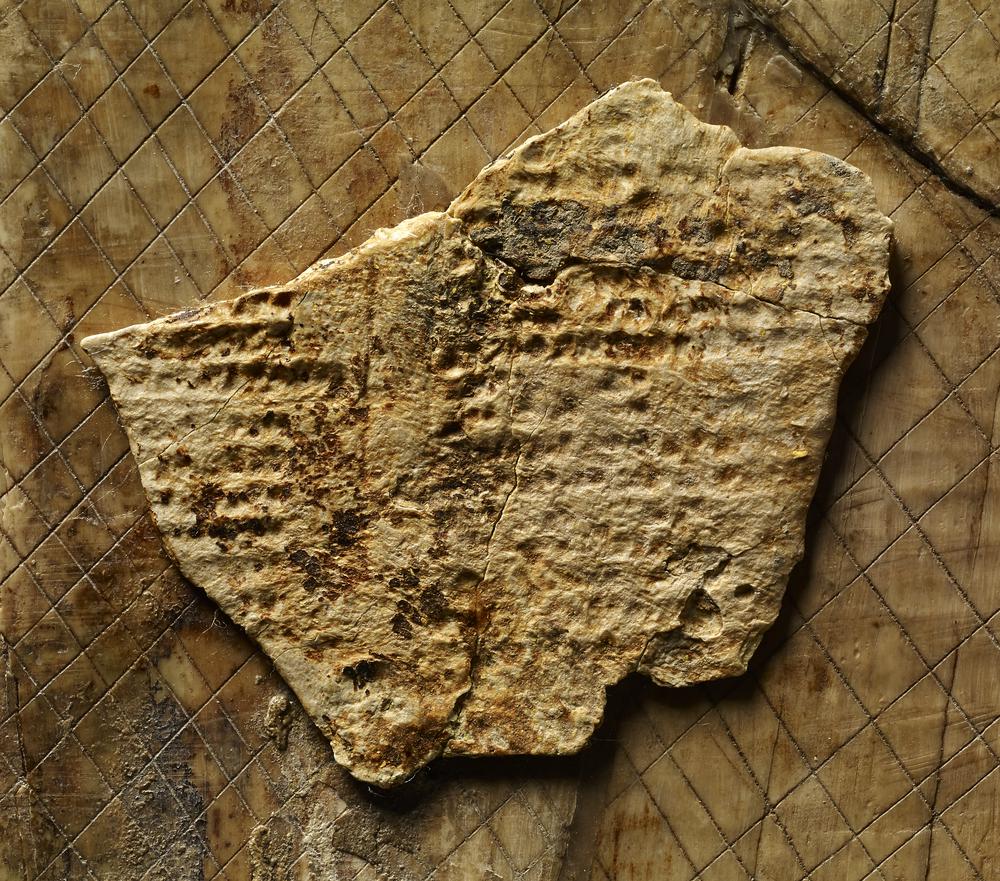
A wax tablet is not simply a neutral support made reusable. Writing displaces matter. A stylus cuts lines and raises ridges within a shallow layer held by a frame. The blunt end can smooth the wax so that the surface accepts another inscription. Reversibility is built into the object, but freedom is not. Someone still controls the model, the task, the timing and the moment of erasure.
Plato’s Theaetetus turns this material practice into a model of memory and false judgement. Socrates asks his interlocutors to imagine a block of wax in the soul. Perceptions and thoughts leave impressions upon it as signet rings press their forms into wax. Memory depends on the mark holding. Error arises when a present perception is matched to the wrong retained impression. The wax may be purer or less pure, harder or softer, more or less capable of receiving a distinct form.2
The metaphor gives cognition a material condition, but it also distributes quality unevenly. Some minds are praised for clean retention while others are described through muddiness, hardness or instability. Difference in knowledge becomes difference in the assigned surface. The image does not merely explain memory. It turns intellectual capacity into a question of material fitness.
Aristotle’s writing surface works differently. In De anima, mind before thinking is compared to a tablet on which nothing actually stands written. The emphasis falls on potentiality rather than retained impressions.3 Locke later asks the reader to suppose the mind to be ‘white paper, void of all characters’.4 Wax, tablet and paper do not form one stable metaphor. They differ in colour, resistance, temporality and the marks they invite. Treating them as interchangeable erases the material distinctions through which they think.
Those philosophical figures do not dictate educational practice. A metaphor is not a lesson plan. Yet metaphors distribute agency before instruction begins. A surface can be understood as selective and resistant, or as passive matter awaiting form. The difference determines how easily learning becomes indistinguishable from manufacture.
A school tablet from second-century Egypt makes that problem difficult to keep abstract. A teacher wrote two maxims in Greek as models. A pupil copied them twice between ruled lines, repeatedly omitted the opening sigma and compressed the final line into the remaining space. The object preserves instruction and mistake on the same surface. It also preserves their asymmetry. One hand supplies the authorised line. Another tries to inhabit it.5
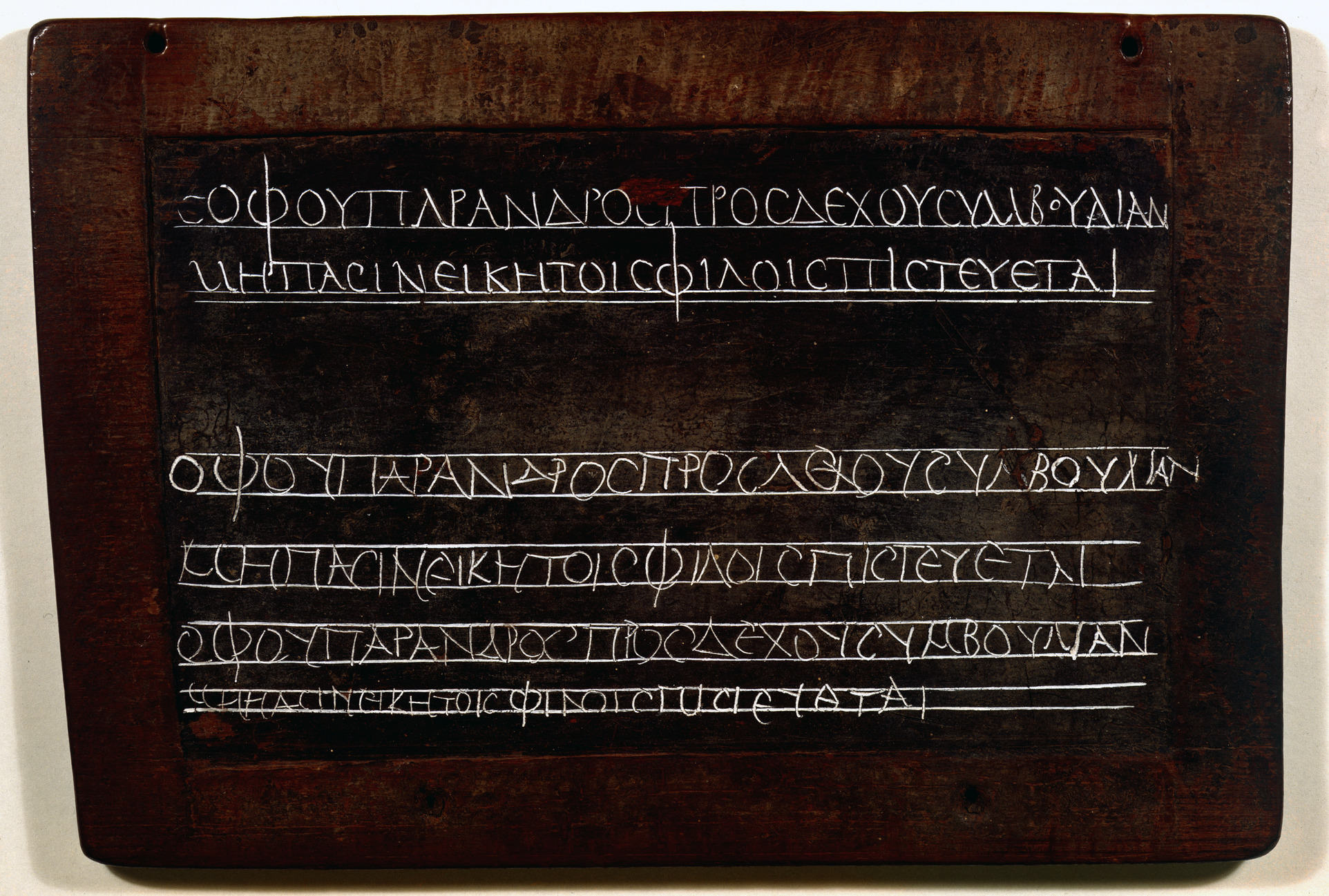
The tablet’s reversibility is easy to praise. A failed line need not become a permanent archive. The same support can hold an exercise, release it and accept another. But the possibility of correction can also prolong correction until the desired form appears. A surface that can be written again can be disciplined again.
This is where the child enters the wax genealogy. Educability and availability draw dangerously close. Openness may name the capacity to learn, alter and exceed an inherited form. It may also make the child appear as material for somebody else’s design. The problem is not that education leaves marks. A pedagogy without memory, imitation or correction would be empty. The sharper question concerns control over inscription. Who establishes the model? Who identifies the error? Who may smooth the surface and who decides that the right form has appeared?
Teachability does not confer ownership. No institution acquires unlimited rights over a person because learning requires exposure and practice. A politically alert pedagogy must preserve more than the possibility of correction. It must preserve the learner’s capacity to contest the model, resist the timing of correction and participate in deciding what should remain. The alternative to coercive inscription is not a surface without marks. It is a surface whose marks remain open to negotiation.
Image
A face can make its material conditions disappear.
Romano-Egyptian funerary portraits make that disappearance particularly easy. The depicted person arrives with an immediacy that binder, support, coating and later intervention rarely receive. To reproduce the portrait only as a face would repeat that hierarchy. To isolate the magnified surface completely would create another convenience: material without the person from whose funerary image it was taken.
The technical figure keeps both fields in view. The portrait remains a likeness of a dead person. An arrow simultaneously identifies part of the painted tunic as a sample location. Under magnification, that area becomes a field of cracked coating and separated islands of material.6
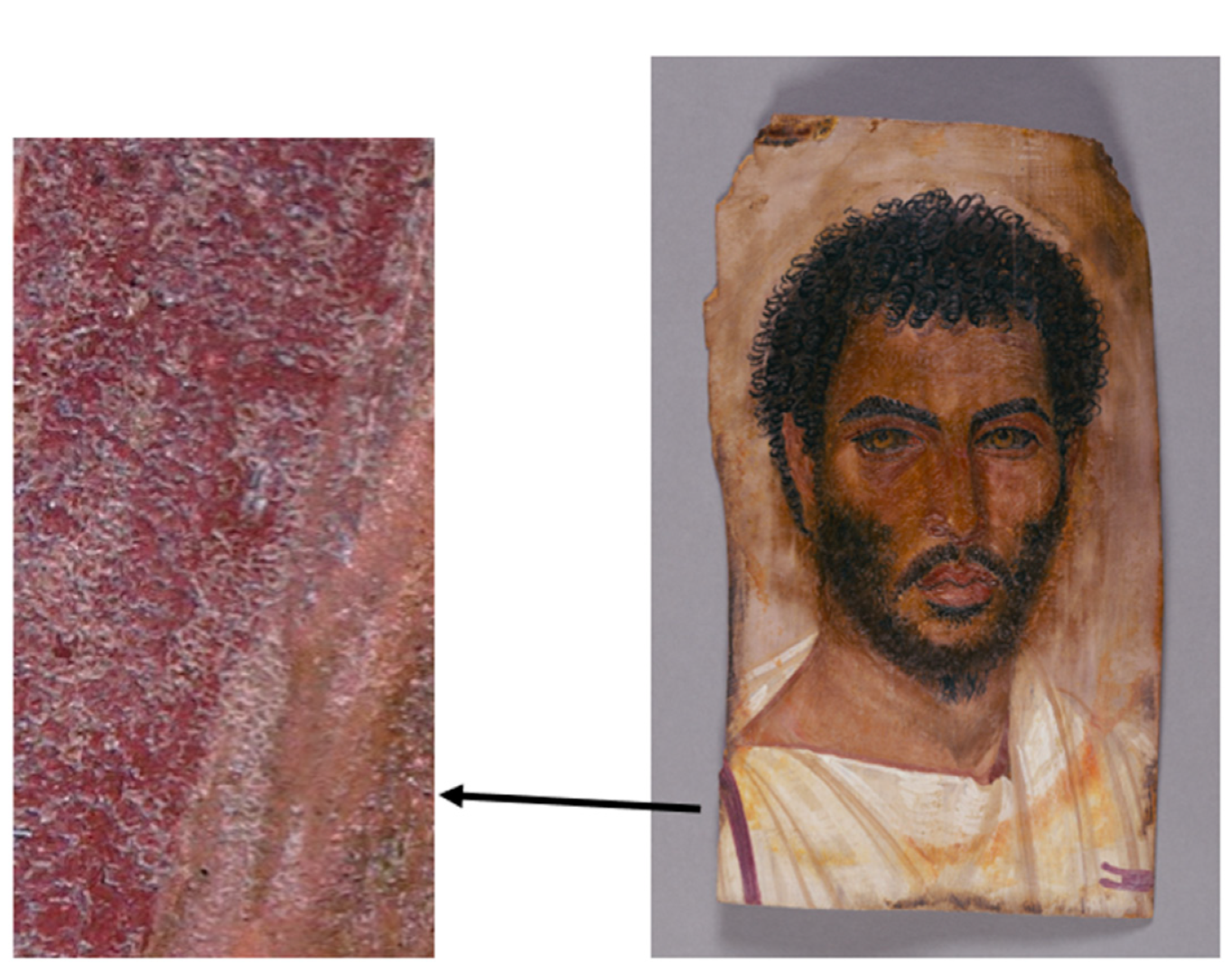
In this figure, scientific imaging does not cancel the portrait. It partitions it. The same surface is made available in different ways: as a person’s image, as a location within a panel and as matter prepared for analysis. The partition produces knowledge, but it is not neutral. It decides where to look, what to enlarge and which material difference may count as evidence.7
The crop reproduced here performs another partition. It retains the relation between portrait, sample location and magnified surface while removing the chromatogram through which the coating was chemically identified.
The analysis complicates rather than purifies the object. GC/MS identified egg in the cracked coating, but the study did not settle whether the layer belonged to the ancient making of the panel or to a later treatment. Scientific examination does not recover one untouched origin beneath the image. It reveals a surface carrying several possible histories at once.
Technical research also cautions against forcing Romano-Egyptian painting into a clean opposition between encaustic and tempera. Binding media vary, historical recipes are incomplete and later treatment complicates what can be identified as ancient material. Visual appearance does not establish technique on its own.
None of these surfaces reaches the essay directly. The Nimrud board is held and photographed in London. The school tablet is filtered through a manuscript collection, digitisation and open-image release. The portrait and coating become visible through conservation photography, magnification, sampling and chemical analysis. The archive does not merely preserve a mark. It produces the conditions under which that mark can now be seen.
For image studies, this matters beyond the identification of wax. Surface is not the final skin of an image after meaning has formed elsewhere. It is where visibility acquires texture, duration and force. Pigment, binder, support, damage and later examination organise the conditions under which an image persists. What a surface holds includes the labour that made it and the institutions that later decide how it may appear.
Seal
By the time wax hardens, the hand that pressed it has withdrawn.
What remains is expected to stand for an absent source. A form becomes attributable not because pressure is still present but because its trace is recognised.
Sealing is older and wider than wax. Long before European documents carried hanging wax impressions, seals worked across stone, clay, metal and other materials. A form is pressed into another surface, made repeatable and attached to a person, office, transaction or boundary.
Wax changes this practice because it can be softened, placed on a document or closure and pressed with a matrix. Once cooled, it carries a form associated with a recognised source. It can authenticate, assign and make interference visible. Softness is not the opposite of authority here. It is one of its conditions. The material must yield before it can harden into a mark that is treated as standing.8
The authority of the seal does not arise from wax alone. It depends on a matrix, conventions of recognition, custody and the power to decide what counts as intact. Pressure becomes attributable because an institution assigns force to the resulting trace. The image on a seal does not merely decorate authority. Its repeatable impression helps perform it.
Each impression remains materially singular. Wax varies, edges break and attachments strain. Yet recognition depends on the image being sufficiently the same. Authority manages a relation between variation and identity. The mark must be repeatable enough to count and particular enough to bind an act to an office or person.
A seal also controls duration. Its force depends on the claim that the impression now stands. The writing tablet remains available for smoothing. Between seal and tablet lies a conflict over revision. Who may reopen the surface? Which marks can be corrected and which acquire protection from further work?
Contemporary administration rarely relies on hanging wax seals, but it still converts marks into authority. A signature, time record or portal confirmation can determine when an act entered a procedure, who is deemed to have acted and whether an obligation was met. This is not a simple genealogy in which a digital record is an old seal in new clothing. The media and institutional arrangements differ. What persists is the need to make acts attributable and enforceable through surfaces.
The political problem begins when the mark is treated as self-explanatory and the conditions of its production disappear. A time stamp may look neutral while access to the portal, control over the file and authority to interpret the entry remain unequally distributed. Surfaces can stabilise accountability. They can also conceal the organisation that made one trace decisive and another irrelevant.
The beeswax inside the mate cup did none of this. It did not authenticate the vessel, certify its age or establish the truth of the wood seller’s description. It carried no office and authorised no claim. It closed a route taken by water.
Later use strengthened the evidence without turning the intervention into a final solution. The cup remained watertight through repeated fillings, heat, yerba and two further curing cycles. The repair moved from a staged test into ordinary practice. Its success became repetitive rather than absolute.
That distinction protects repair from two familiar fantasies. The first imagines restoration as a return to an uncontaminated original state. The second treats damage as automatically valuable because it produces a visible story. The mate cup supports neither claim. The manufacturing scar remains, but it no longer dictates the object’s function. The repair matters because it changes what the object can do.
Wax performs differently across these histories. It supports palace knowledge, retains a school exercise, gives philosophy models of memory and potentiality, binds pigment into a paint body and hardens under a matrix into authority. The repair belongs to this field without collapsing into any of these other uses. It does not educate, depict or authenticate. It remains open to further work.
That openness is not innocence. Every repair selects what to preserve, what to cover and which future use deserves support. Even a small intervention redistributes attention and duration. Yet the possibility of returning to the surface distinguishes maintenance from the authorised finality of the seal.
A surface does not become political only when an explicit message is written upon it. Politics is already present in the allocation of pressure, revision and permanence. Some marks may be corrected without consequence. Others become evidence. Some surfaces are protected as images while others are treated as endlessly available for improvement. The question is not simply what a surface holds. It is who decides what must hold.
The wax did not erase the puncture. It prevented the vessel from being reduced to it.
Notes
- British Museum, writing-tablet, registration no. 1954,1115.1, 720–710 BCE. The museum identifies it as one of sixteen ivory boards scored to receive wax. An inscription on one board links the set to Enūma Anu Enlil and states that it was intended for the palace of Sargon II at Khorsabad. ↩
- Plato, Theaetetus, 191c–196c, especially the wax-block and signet-ring model of memory and false judgement. ↩
- Aristotle, De anima III.4, 429b30–430a2. ↩
- John Locke, An Essay Concerning Human Understanding, II.i.2. ↩
- British Library, Add MS 34186, School Exercises with Menander’s Sententiae, Multiplication Table and List of Words, second century CE. Tablet 1 contains two model lines and two pupil copies. ↩
- Joy Mazurek, Marie Svoboda and Michael Schilling, ‘GC/MS Characterization of Beeswax, Protein, Gum, Resin, and Oil in Romano-Egyptian Paintings’, Heritage 2, no. 3 (2019), 1960–1985, especially fig. 6 and section 3.7. The portrait, JPGM 74.AP.11, is painted in beeswax. The magnified area shows a white cracked coating on the purple tunic stripe. GC/MS amino-acid analysis matched egg. The authors leave the coating's historical relation to the ancient panel and possible later treatment unresolved. ↩
- For scientific images as historically organised practices of selection, intervention and disciplined seeing, see Lorraine Daston and Peter Galison, ‘The Image of Objectivity’, Representations 40 (1992), 81–128. For the material preparation of scientific visibility, see Michael Lynch, ‘Discipline and the Material Form of Images: An Analysis of Scientific Visibility’, Social Studies of Science 15, no. 1 (1985), 37–66. ↩
- The National Archives (UK), ‘Seals’. ↩
Image Credits
Nimrud writing board. British Museum, registration no. 1954,1115.1, image asset 1490089001. © The Trustees of the British Museum. CC BY-NC-SA 4.0.
School exercise on wax. British Library, Add MS 34186, no. 1. Digital image released through Flickr Commons and Wikimedia Commons. CC0 1.0.
Portrait, sample location and cracked coating. Cropped from Joy Mazurek, Marie Svoboda and Michael Schilling, 2019, fig. 6. J. Paul Getty Museum portrait JPGM 74.AP.11, 150–170 CE. The crop retains the portrait, sample-location arrow and 20× light-microscope detail of the cracked white coating while omitting the GC/MS chromatogram. Image by Marie Svoboda. CC BY 4.0.
Cite As
Tobias Daum, Imprint and Seal: Beeswax, Repair and What a Surface Holds, Stelle 39 02 (2026), https://stelle39.com/imprint-and-seal/.