Twice, a local court told me that, as a Privatperson, I would not be granted access to the case file. Twice, the refusal appeared not as an order but as a Hinweis. The practical effect was clear. Its legal form was not.1
A Hinweis can point, advise or draw attention. It need not decide. In these letters, however, the word carried more than information. It closed a route while declining to name the closure in the form ordinarily associated with a judicial decision. There was no separate operative order, no stated legal basis and no information on remedies. The court had acted. I had to decide whether it had decided.
This was not a semantic puzzle added to the procedure from outside. It changed what the procedure demanded. If I treated the letters as mere notices, a later court might regard the refusal as sufficiently clear and my challenge as late. If I challenged them as decisions, the challenge might fail because no decision had supposedly been made. The ambiguity did not suspend the practical result. It moved the risk of naming that result.
Organisations are often described as if clarity were their natural language and ambiguity a defect. Eric Eisenberg reversed that assumption. Ambiguity, he argued, can perform organisational work. It can preserve privileged positions because different audiences can act on different meanings without forcing the organisation to settle on one.2 The point here is not that an individual judge consciously designed a strategy. Intention can remain open. The institutional effect is visible without it. One side retains several readings of its own act. The other must choose one under deadline, cost and uncertainty.
The result is not indecision. It is a distribution of decision-making. The institution produces the effect. The party inherits the labour of determining what that effect legally is.
This distribution also changes the meaning of clarity. For the recipient, clarity is required in advance. The correct address, application, deadline and remedy must be identified before consequences harden. For the institution, clarity can be deferred. The meaning of its act may be settled later, in response to the party’s reaction. One side must anticipate the form. The other can retain the power to describe the form retrospectively.
Room
The file mattered before access to it was refused. It had already entered the home as an unequal distribution of knowledge.
On 4 March 2026, a court held an on-site inspection in the apartment at the centre of the dispute. The landlord’s statement of defence was dated 20 February and bore a court mark showing that it had been presented by 25 February. The residents did not receive it before the inspection. It was handed to them only after the recorded end of the appointment.3
The sequence matters because the document did not merely list technical objections. It contained evaluative claims about how the residents used the apartment and communicated with the landlord. The court and the opposing side therefore entered the home with a written frame that the people living there had not been able to read.
The apartment was not simply an object waiting to become evidence. It was where bodies slept, worked, cooked and tried to recover. Moisture, odour and damaged surfaces did not occupy a neutral inspection site. They occupied a home. During the appointment, that lived space was temporarily reorganised as a procedural space. Rooms became locations of proof. Surfaces became observations. Duration was divided into inspectable moments. The unequal access to the statement of defence shaped who entered this conversion prepared and who did not.
The asymmetry was not merely that one side possessed more information. The unseen document had already organised attention. It supplied possible motives, behaviours and explanations through which the apartment could be read. The residents could point to walls, air and damaged materials. The opposing account arrived as text already addressed to the institution. The room and the document did not enter the procedure on equal terms.
Six days later, I requested access to the file. The request was not a general demand for documentary completeness. It asked for the traces of how the statement of defence had been handled: receipt, review, judicial direction and transmission. It also sought the inspection record, judicial notes and any provisional recordings. The request followed the asymmetry back to the institution that had organised it.
Administrative burden is usually described through the learning, compliance and psychological costs that arise when people deal with the state. Donald Moynihan, Pamela Herd and Hope Harvey add a political claim. The level and distribution of those burdens are not necessarily accidental. Their opacity can allow consequential changes in access to occur without becoming broadly visible as policy.4
The case file introduces a related but more specific burden. Before learning how to respond to a rule, the party must determine whether a rule, refusal or decision has been issued at all. This is an interpretive burden. It is not merely the difficulty of understanding legal language. It is the work of reconstructing the institutional status of an act whose author has left that status unsettled.
The wording of the letters intensified this displacement. They did not distinguish between a party to proceedings and an outside third person. They said that file access could not or would not be granted to a Privatperson and that a lawyer could receive it instead.5 The operative distinction became one between a professional representative and a private person. My actual position as a party receded behind the absence of a professional title.
That substitution is easy to dismiss as loose wording. It is more precise to ask what the looseness does. The category Privatperson changes the scene of access. A person already inside the procedure is linguistically placed near its edge. The letter then presents professional representation as the route back in.
The linguistic displacement matters because roles in a procedure are not descriptions of social identity. They determine capacities. A party can submit, receive, contest and seek review. Privatperson names none of these relations. It describes what the addressee is not: not counsel, not institution, not professional bearer of the file. The word appears ordinary and almost neutral. In this setting, its ordinariness removes the very procedural relation on which the request was based.
The problem is not that professional representation is never useful. It is that a procedural right becomes materially dependent on a resource that parties do not possess equally. Two people may conduct the same housing case, sign the same pleadings and stand in the same apartment without having the same money, time or access to legal assistance. Formal equality does not equalise the material conditions under which a right can be exercised.
Ambiguity and burden therefore meet at a concrete point. The institution retains uncertainty about the form of its own act while the party must purchase, learn or improvise the means of responding to it. The burden is not simply additional paperwork. It is the transfer of clarification work from the actor with authority to the person subject to its effects.
Caption
A second document sharpened the mechanism because it was never served at all.
In a judicial order dated 4 June, the parties appeared for the first time as “claimants and counter-defendants” and “defendant and counterclaimant”. No counterclaim had been delivered to the claimants. After an inquiry, the court stated on 22 June that a counterclaim had been received but withdrawn before its service was ordered. The altered party labels, it explained, had been assigned prematurely.6
A document the affected side had never seen had already changed the visible grammar of the proceedings. The counterclaim did not reach them as a served claim. It nevertheless entered the caption of a judicial order and recoded their role.
The court later called the designation premature. That description narrows the event to timing, as though the correct label had simply arrived before its appointed moment. Yet the sequence also reveals something about institutional visibility. Withdrawal prevented the counterclaim from becoming a served demand. That withdrawal did not prevent the court’s internal handling from leaving a visible procedural trace. The act disappeared as claim and remained as role.
A caption may appear peripheral to the substantive dispute. It does not decide whether a wall was damp or a rent reduction justified. Yet it is not decorative. It tells the document who is present and in what relation. It converts people into procedural positions. The premature label did not merely describe an event. It made the event legible as if it had already taken place.
Cornelia Vismann’s work on files is useful here because it refuses to treat the file as a passive container. Filing practices do not simply store a legal world that exists elsewhere. They mediate and process law, producing relations between subject, institution and record.7 The file does not control reality. It controls sequences, attachments, addresses, roles and the conditions under which a version of reality can become institutionally operative.
This does not mean that every clerical trace is a sovereign decision. It means that the distinction between record and act is less stable than administrative common sense suggests. A role can be entered before the originating document is served. A statement can frame an inspection before the residents receive it. A refusal can steer conduct before it is named as a decision.
Inside the file, the invisible acted with precision. Outside it, the visible had no settled name.
Peter Bachrach and Morton Baratz called attention to nondecision-making as a face of power. Their argument concerned the capacity to limit actual decision-making to safe issues by shaping institutions, procedures and the field of what could become contestable.8 The mechanism here is not identical. The request for file access was not kept entirely outside consideration. The court responded. The response produced a practical result. What remained unavailable was a stable decision-form to which the party could attach a stable procedural reaction.
This suggests an operative nondecision. The phrase does not describe an absence of action. It names the separation of decision-effect from decision-form. Something is closed, withheld or recoded. The institution does not fully bind itself to the form through which that effect could be reviewed.
Such a form is not weak. Its strength lies in the uneven futures it keeps available. Compliance preserves the practical result. Challenge can be met with a dispute about admissibility or timing. Delay accumulates on the side seeking access. The original act remains able to move between notice, direction and refusal.
Strategic ambiguity is often discussed as a way of delegating discretion. In some organisations, open wording can give actors real room to interpret and act. Here the party receives discretion without authority. I could choose how to read the Hinweis, but I could not determine its legal status. I was responsible for the interpretation without possessing the power to settle it.
File
The digital infrastructure made the asymmetry more visible rather than resolving it.
The same court later sent an order and further correspondence through Mein Justizpostfach, the secure electronic mailbox available to citizens. The messages arrived with XJustiz containers and technical metadata. The route existed, was known to the court and worked in practice. The file itself remained closed.9
A one-way channel is still a channel, but it does not create a shared procedural space. The court could send out. The party could not look back in.
The distinction matters because digital accessibility is often presented as a property of interfaces. A portal exists. A message can be transmitted. A PDF opens. Yet access depends less on the presence of a visible button than on the institutional operations behind it. The electronic file-inspection portal provides a technical route for remote access, but the route becomes usable only when a judicial body releases material into it. The technical return path can exist while institutional permission to use it remains withheld.
Recent research on administrative burden has begun to treat material and virtual artefacts as active components of governance rather than neutral surroundings. Forms, counters, waiting rooms, screens and digital systems shape how citizens encounter authority and which costs they absorb.10 In a legal procedure, the artefact is not merely inconvenient. It can allocate evidence, time and legibility.
The XJustiz container is a good example. Beneath the visible letter are structured message types, timestamps, sender roles and delivery information. A self-represented party may have to preserve and inspect these layers simply to reconstruct when and how something was transmitted. The interface permits transmission while leaving the recipient to make that transmission evidentially legible.
This labour is easily misread as personal over-documentation. Screenshots, exported messages, hashes, filenames and delivery records can look excessive when the procedure is imagined as a sequence of self-explanatory letters. They look different once the legal character, timing and routing of those letters become contestable. Documentation expands because the institution’s act does not arrive with all the certainty that its consequences may later acquire.
This is where the procedural mechanism returns to housing. The case file is not politically significant because files are mysterious or because every missing document hides misconduct. It matters because the file is the institutional form in which a home becomes a legally decidable object.
Lived housing conditions enter the procedure through photographs, measurements, descriptions, dates, medical effects, rent calculations and competing accounts. This translation is necessary. A court cannot decide directly from the totality of lived experience. But translation is never only reduction. It also orders. It determines which duration becomes an event, which surface becomes evidence and which account receives procedural continuity.
Without access to the file, the residents cannot fully inspect that ordering. They cannot see which version of the home has been preserved, when a hostile description entered the record, how it was routed or which invisible documents altered their formal role. The denial concerns more than information. It concerns access to the machinery through which their living space is made institutionally legible.
The three scenes are not interchangeable. In the apartment, an unseen text framed a visible space. In the caption, an unseen claim altered a visible role. In the Hinweis, a visible refusal withheld a stable form. Together they show a distribution of precision.
The file can act precisely on material that remains invisible to the party. The party, by contrast, must act precisely on institutional communication that remains ambiguous.
No general theory of judicial power follows automatically from one housing case. Nor is intention established by the consequences described here. The point is narrower and harder. A mechanism does not need to be planned in every instance to be institutionally useful. Ambiguity preserves options. Files stabilise effects. Burdens of interpretation, compliance and proof travel outward.
A legal system does not need to abolish a right openly in order to make its exercise difficult. The right can remain formally available while its use is relocated into a sequence of uncertain designations, professional thresholds, technical permissions, deadlines and costs. Each element may appear minor. Together they decide who must keep working before the institution is required to speak clearly.
Documentation does not reverse that distribution by itself. It can establish dates, wording and metadata. It can show that one document arrived before another, that a role changed and that a secure channel was used. It cannot compel the institution to name its act. The dossier records what happened. The essay asks what kind of power can happen that way.
The first letter was clear enough to stop access and unclear enough to make the next step uncertain. The second repeated the operation. I did not only have to challenge the refusal. I first had to decide whether the court had decided.
Notes
- Local court letters dated 17 April and 22 June 2026, held by the author. ↩
- Eric M. Eisenberg, ‘Ambiguity as Strategy in Organizational Communication’, Communication Monographs 51, no. 3 (1984), 227–242, esp. 236–238. ↩
- Statement of defence dated 20 February 2026, court presentation mark dated 25 February 2026 and inspection record dated 4 March 2026, held by the author. ↩
- Donald Moynihan, Pamela Herd and Hope Harvey, ‘Administrative Burden: Learning, Psychological, and Compliance Costs in Citizen-State Interactions’, Journal of Public Administration Research and Theory 25, no. 1 (2015), 43–69, esp. 43–47. ↩
- Local court letters dated 17 April and 22 June 2026, held by the author. ↩
- Judicial order dated 4 June 2026 and court letter dated 22 June 2026, held by the author. ↩
- Cornelia Vismann, Files: Law and Media Technology, trans. Geoffrey Winthrop-Young (Stanford: Stanford University Press, 2008); German original, Akten: Medientechnik und Recht (2000). ↩
- Peter Bachrach and Morton S. Baratz, ‘Decisions and Nondecisions: An Analytical Framework’, American Political Science Review 57, no. 3 (1963), 632–642. ↩
- MJP and XJustiz messages, containers and delivery records from June 2026, held by the author. Under § 299 Abs. 1 und 3 ZPO, parties have a statutory right to inspect case files; where files are electronic, inspection is granted by making their contents available for retrieval or by secure transmission. The Federal and Länder file-inspection portal states that the authority maintaining the file decides on inspection and provision through the portal. No claim is made that the complete court file was maintained electronically. ↩
- Muhammad Azfar Nisar and Ayesha Masood, ‘Governance by Artifacts: Theory and Evidence on Materiality of Administrative Burdens’, Public Administration Review 84, no. 6 (2024), 1052–1066. ↩
Image Credits
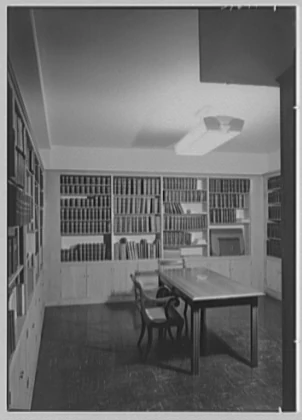
Record room, 1951. Gottscho-Schleisner, Inc., American Bureau of Shipping, 45 Broad St., New York City. Record room, 25 June 1951. Gottscho-Schleisner Collection, Library of Congress, Prints and Photographs Division. Reproduction no. LC-G612-T-59644. Call no. LC-G612-59644 [P&P]. No known restrictions on publication. Library of Congress record.
Cite As
Tobias Daum, Deciding Without Deciding: File Access, Housing and the Work of Institutional Ambiguity, Stelle 39 03 (2026), https://stelle39.com/deciding-without-deciding/.