Most mornings, the barrier rose before I had fully stopped. The officers had begun to recognise the bicycle. I still slowed down. The crossing remained conditional. A stop, a question or a request to dismount was always possible. Usually none of this happened. The possibility was enough to organise the movement.
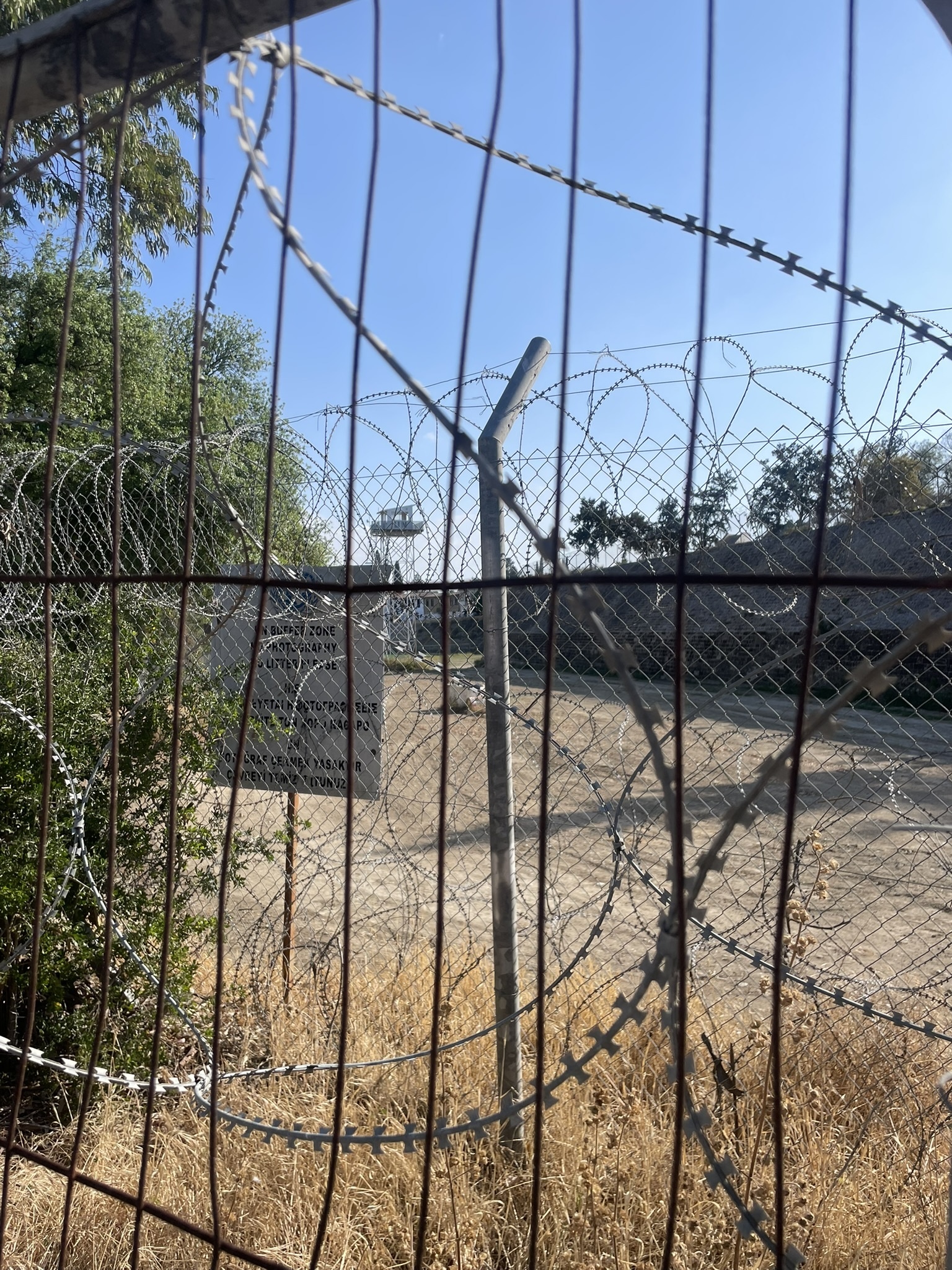
Before the barrier came several layers of fencing. Wire crossed wire at different depths. Behind it stood a watch post and, improbably, a tennis court. The arrangement had become part of the route before it became an image. Its force lay less in spectacle than in repetition. Metal, authority and ordinary leisure were compressed into the same field of vision.
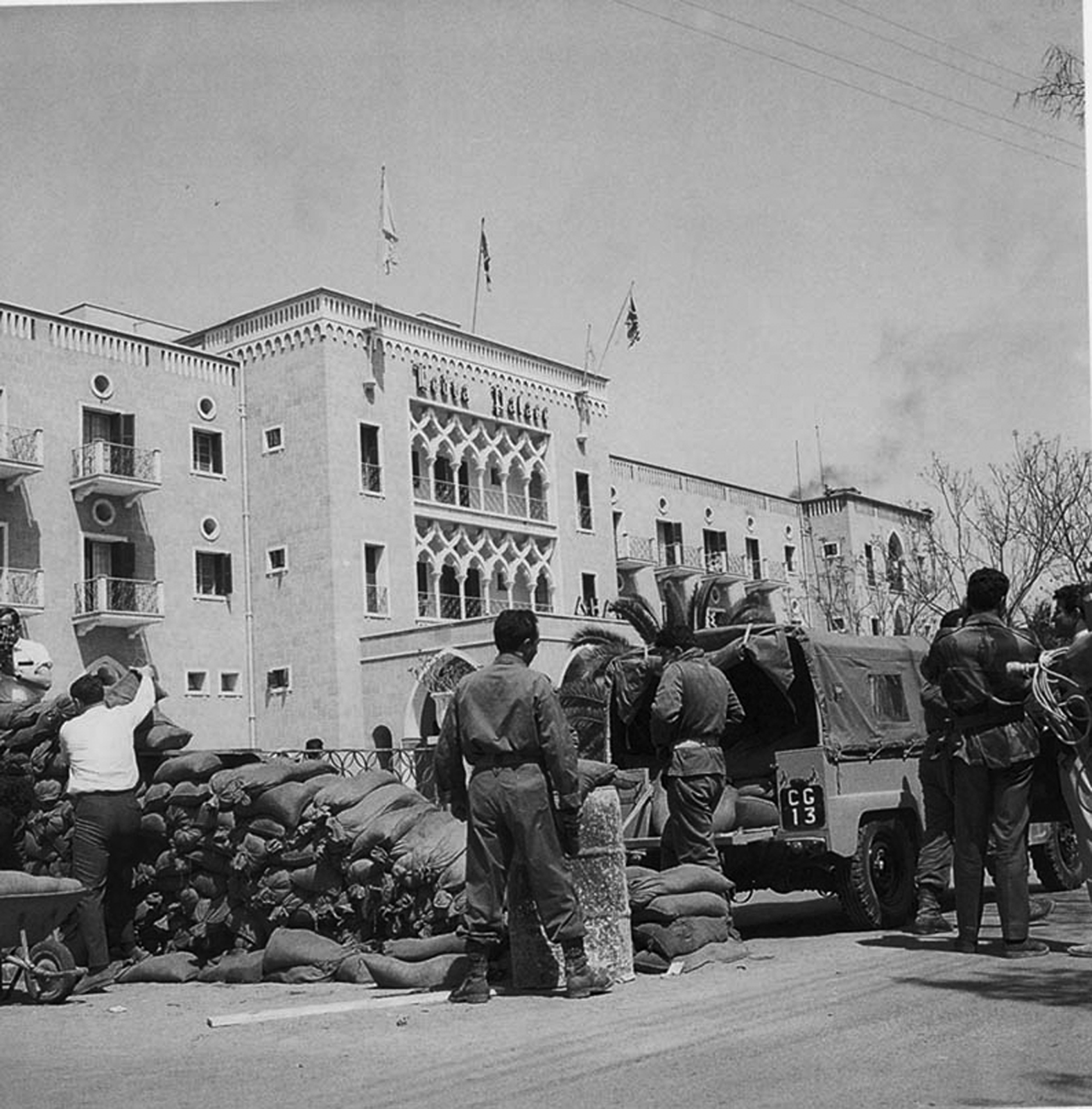
A photograph from early 1964 shows the Ledra Palace Hotel behind sandbags, with armed men gathered around a vehicle at the first checkpoint established outside the building.1 It does not record the beginning of a timeless border. Separation was produced through the intercommunal violence of 1963–1964, then consolidated in its present form after the ceasefire of August 1974.2 Ledra Palace became one of the first crossing points opened on 23 April 2003.3 My own passage belonged to that later arrangement. It was limited, routine and reversible. A barrier could lift while the political condition that required it remained unresolved.
A few minutes later, the route ended at a cultural institute inside the buffer zone. Its immediate neighbours included the Ledra Palace Hotel, the Home for Cooperation, diplomatic residences, deteriorating buildings and UN-controlled roads. The concentration of these places made the division impossible to ignore. It also made it easy to treat the division as the whole meaning of the city. Checkpoints, interrupted streets and abandoned buildings can become an explanation before Nicosia has had a chance to appear.
Berlin supplied an available European comparison. The Green Line has repeatedly invited comparison with post-war Berlin.4 The analogy identifies the force of a controlled line through a capital, but it also imports an ending: the fall of the Wall, reunification and a culture of memorialisation. Nicosia can then appear as a city waiting to complete a European sequence already finished elsewhere. The comparison is useful only if it is allowed to fail.
The institute was the Goethe-Institut. Its name travelled through the city with an ease that the checkpoint did not. One task made this visible. While distributing posters for a film programme, I encountered immediate recognition in cafés, bookshops and cultural spaces. Reputation opened doors without presenting itself as a form of access. That ease was part of the institution’s power.
At the checkpoint, the condition was declared. Elsewhere it appeared as an application form, a meeting invitation, an external email address or a list transferred from one phone to another. Different mechanisms decided who could enter, what could circulate and whose movement became useful.5 One of them had a budget, a selection procedure and an explicit European objective.
Europe as a Route
The application began with proof of identity, academic records, language evidence and a proposed course of study. Once assembled, these materials converted a political relation into an individual route. The principal EU Scholarship Programme addressed Turkish Cypriot students, graduates, researchers and professionals seeking education or training in the European Union. It covered undergraduate and postgraduate study, research, professional training and language learning. By 2020, fourteen annual schemes had delivered more than 1,800 awards. A 2022 programme document allocated a further five million euros to cover around 300 awards across 2025–2026 and 2026–2027.6
The grants could remove barriers that would otherwise prevent study abroad. They offered time, qualifications, travel and professional contact. The programme belonged to an aid structure designed to facilitate reunification through economic development, contacts between the communities and preparation for EU law. Its aims included addressing skills gaps, improving qualifications, increasing knowledge of EU languages and contributing to a positive image of the Union among Turkish Cypriots.7 Real support and political purpose were designed to operate together.
No declaration of political loyalty was required. The programme’s political work lay in selecting people, financing mobility and placing qualifications and professional futures within an explicitly European frame.
The British Council had administered the programme since 2014. In April 2022, the Commission signed a five-million-euro agreement with the Goethe-Institut, while the British Council completed the ongoing calls during a two-year transition.8 Brexit did not end the programme. It changed the institution through which it operated.
The programme spoke differently in public: ‘Be curious. Learn. Grow. Share.’9 Beneath the four imperatives sat the EU and Goethe-Institut logos. A political programme was translated into the language of individual development.
A Commission decision from December 2022 brought another choice into view. The original financial programme included an upgrade of the medium-voltage electricity network in the Turkish Cypriot community. The Commission concluded that political and operational conditions did not permit the project to proceed under the required standards of financial management, cancelled it and reassigned the funds as advance provision for scholarships.10 It recorded a narrower institutional judgement: investment in the network could not proceed, while investment in selected mobility could.
Beyond the main programme, the corridor narrowed. A separate United World Colleges scheme selected two cohorts of ten teenagers, five Greek Cypriot and five Turkish Cypriot students in each. Candidates were assessed according to merit, potential and aptitude. The Commission participated in selection committees, described the recipients as ‘high-potential scholars’ and stated that the programme aimed to educate ‘future civic leaders from both communities’.11 Narrower still, for the 2022–2023 academic year, the College of Europe offered up to three full scholarships to ‘exceptional Turkish Cypriot individuals’, covering tuition, accommodation, meals, a stipend and travel.12
These programmes were separate. Their proximity still matters. The Goethe programme distributed educational mobility across a comparatively large group. UWC organised small bicommunal cohorts around civic leadership and reconciliation. The College of Europe opened a highly selective route into postgraduate European studies. Together they arranged access at different scales for different anticipated forms of influence. Selection criteria did not simply rank applicants. They also defined which forms of preparation, mobility and institutional familiarity counted as potential.
The documents do not show how recipients later used the opportunities. They do show what the programmes were built to organise. European institutions selected routes, financed movement and connected qualifications and professional futures to the Union. Inside the organisation implementing the largest programme, access could be sufficient for work while remaining incomplete for learning.
Partial Access
A delayed reply to questions about my role arrived while I was working in the Severios Library. Outside, it was thirty-six degrees. The air conditioning was not functioning, and a member of staff brought me a fan. The intervention was small and direct. Someone at a desk needed air, so the desk was made usable. I left the message unopened for a while.
The library did not resolve the conflict. It provided a place in which the conflict could be read. Exclusion had not been complete. I had a desk, attended weekly meetings, contributed to a film programme and researched cultural projects. My own route to Nicosia had also been financed through Erasmus+. The Learning Agreement named cultural programming, curatorial work and post-conflict society; the internship agreement assigned me to programme and communication.13 I was later asked to take responsibility for the local implementation of a media education project on images, disinformation and critical thinking. Meaningful work had not been absent. Work, learning and recognition had not been held together.
The distinction became clearest in the institute’s digital systems. I could contribute knowledge about tools that colleagues had only begun to explore and consider how a virtual platform might compensate for the absence of a physical library. When internal training on artificial intelligence and GoetheVRsum became available, I could not register. The system required an internal email address; I had been given an external one. The obstacle looked technical. Its effect was institutional. The same account that allowed me to complete work marked me as outside the system through which the organisation distributed learning.
Partial access is easy to overlook because the person remains present. Tasks are completed and messages exchanged, allowing the arrangement to appear functional. An institution can receive someone’s work while leaving that person to carry the uncertainty surrounding it. Responsibilities may be offered informally and later narrowed; questions about authority move between conversations, emails and levels of management. Participation continues, but the conditions that would make it legible as learning, responsibility or membership remain unsettled.
The scholarship programme and the internship were structured at different scales and under different mandates. Their proximity inside the same organisation nevertheless exposed a contradiction. The programme defined categories, budgets, eligible routes, expected results and a decision-making structure. My own institutional position was less legible. An organisation entrusted with educational mobility could leave learning in its workplace dependent on an email domain, an informal role and the willingness of individuals to improvise.
The library offered no grand alternative. It had rules, opening hours and material limits, and its air conditioning was broken. The fan matters for a narrower reason. At the institute, small obstacles repeatedly became questions of role, permission and responsibility. In the library, a small obstacle remained small.
Writing did not restore the access that had been missing. It made its distribution easier to see. A European programme could finance movement across borders and into universities. A cultural institute could accept work without fully providing entry into its learning systems. A public library could make one desk usable for an afternoon. Passage concerned not only crossing a line but remaining in a room, using its resources and understanding the position one had been allowed to occupy.
Other Ways of Crossing
On 1 May 2025, I observed part of the Labour Day gathering in Eleftheria Square. I remained mainly on the square and understood only fragments of what was being said. The march itself and the later meeting near Ledra Palace became legible only through contemporary reporting. Groups from different parts of southern Nicosia converged at Eleftheria Square before marching towards the buffer zone, while Turkish Cypriot unions gathered separately at Kuğulu Park and approached from the north.14
The square brought together trade unions, parties and youth organisations without turning them into a single political position. From there, the crowd moved towards the buffer zone and joined Turkish Cypriot labour groups near the Home for Cooperation.15 Public presence did not imply unrestricted visual access. I watched participants signal to larger media cameras that they did not want to be filmed, and the operators lowered their equipment. I cannot say whether this expressed a shared policy or the demand of particular people. It established a practical limit nonetheless. Collective visibility did not make every person within the crowd freely available for capture.
The event relied on unions, party structures, speakers and a route prepared for a particular time and purpose. Access to the buffer zone remained controlled. Its form nevertheless differed from the educational routes described earlier. Scholarship programmes selected individuals and financed movement towards institutions elsewhere in Europe. On 1 May, groups assembled separately because the division remained in force, then moved towards the same space through collective organisation and public presence.
Across these scenes, passage was guarded at a checkpoint, financed through scholarship programmes, made partial within a cultural institution and assembled in public. None of these movements removed the structures conditioning them. The political question was who could organise passage, under what authority and for what purpose. The Labour Day marches did not dissolve the line. For a time, they changed what could be done within it.
Notes
- Antigone Heraclidou and Theopisti Stylianou-Lambert, ‘The Ledra Palace Hotel and the “Difficult History” of Modern Cyprus’, Byzantine and Modern Greek Studies 47, no. 1 (2023): 103–122, at 115, fig. 4. ↩
- United Nations Peacekeeping Force in Cyprus, ‘Operations since 1974’, updated 22 November 2025, accessed 20 July 2026. ↩
- Press and Information Office, Window on Cyprus (Nicosia, 2015), 54. ↩
- Petros Papapolyviou, ‘Nicosia, 1950–2024: A Brief History of the City and Its People’, in Sector 2: Λευκωσία_Nicosia (Nicosia: Leventis Municipal Museum, 2025), 291. ↩
- On access as an effective ability organised through multiple mechanisms rather than a formal right alone, see Jesse C. Ribot and Nancy Lee Peluso, ‘A Theory of Access’, Rural Sociology 68, no. 2 (2003): 153–181. ↩
- European Commission, Annex to Commission Implementing Decision C(2022) 9170, 14 December 2022, 31–33. ↩
- Commission, Annex, 2–3, 32–33. ↩
- European Commission Representation in Cyprus, ‘EU Scholarship Programme for the Turkish Cypriot Community for Academic Years 2023–2025’, 4 April 2022; Commission, Annex, 31–32. ↩
- Goethe-Institut Cyprus, ‘EU Scholarship Programme for the Turkish Cypriot community’, campaign graphic, accessed 21 July 2026. ↩
- European Commission, Commission Implementing Decision C(2022) 9170, 14 December 2022, recital 2. ↩
- Commission, Annex, 10–12. ↩
- European Commission Representation in Cyprus, ‘Scholarships for Turkish Cypriots to Study at the College of Europe’, 16 November 2021. ↩
- Erasmus+ Learning Agreement, 22 January 2025, and internship agreement, author’s archive. ↩
- Tom Cleaver, ‘Greek and Turkish Cypriot Trade Unions to Hold Joint Event for May 1’, Cyprus Mail, 29 April 2025. ↩
- Johanna Pauls and Marko Ljubicic, ‘Workers Mark May Day with Calls for Peace, Justice and Better Wages’, Cyprus Mail, 1 May 2025. ↩
Image Credits
Security fencing on the approach to the Ledra Palace checkpoint: photograph by Tobias Daum, 2025.
First checkpoint at the Ledra Palace Hotel: photograph by Cyprus Mail, early 1964. Reproduced from Antigone Heraclidou and Theopisti Stylianou-Lambert, ‘The Ledra Palace Hotel and the “Difficult History” of Modern Cyprus’, 2023.
Cite As
Tobias Daum, Who Gets to Cross? Culture Work and the Politics of Access, Stelle 39 01 (2026), https://stelle39.com/who-gets-to-cross/.